Explore

About me

Am a contradiction of sorts. i love going out and having a good time with friends, and i can also stay home chill out over a book or a movie..

Am very passionate about writing, so give me a topic and watch me float away into wonderland... Love reading books- sometimes i read 3books simultaneously, crazy about music- need it all around me, all the time and ofcourse, i totally am ga ga goo goo over my 7yr old naughty brat- Floppy!! errr, Prince Floppy!! :)
Showing posts with label orissa. Show all posts

Thursday, May 10, 2018

Kedar Gauri Temple, Bhubaneshwar


Bhubhaneshwar, my trip in a nutshell - a jist of all that I did while in Odisha

One friend said Bhubaneshwar is a "City of Temples" and I thought to myself, "Oh my, not another one!!" Years ago when I visited Kumbakonam, I walked around the small town and visited 4 temples, only to be told there were few more... Realised in our country before you can say "hello, how are you" you will have passed not one but two places of worship... 

It is therefore not surprising that Bhubaneshwar was one.. The old town part is filled with many beautiful temples which are reminiscent of a glorious past.

After exploring the Parasurameshwar temple as I walked towards Mukteshwar temple, I noticed one more on the right side. These are all within few yards from each other. The temple was white with red structures and I walked into the gates ... Said to have been built in the 9th Century by King Lalatendu Kesari to commemorate the ill fated lovers who eloped against the wishes of their communities- Kedar and Gouri. Apparently Kedar is said to have killed by a tiger when he went hunting for food, while Gouri committed suicide in the pond when she heard news of his death [the pond today is inside the temple campus].. This has evolved to a point where today lovers/couples come here to pray for marital bliss..This is also one of the eight Astasambhu temples... 

The main deity is Lord Shiva "Kedareswar" and his consort Goddess Gouri. The highlight of this temple is the 8 feet tall statue of Hanuman and Goddess Durga standing proudly on a lion. The temple has a Panch-Rath sanctum and is quite tall at 13+ feet in height.

After spending about 45mins around the temple, I walked towards the gate to head over to the next one. There were quite a few families in the temple, and a couple with a man who claimed he was a guide. They were from Kolkatta and carried a ready reckoner book of sorts that spoke about the temple, the architecture and some stories around it. It was amusing to watch them walk around the temple with the book in hand, comparing notes to the actual sculptures and architecture. Chit chatted with them a while and then we made our way towards Mukteswar temple, which is literally hop skip away. 


Monday, April 30, 2018

Walking around Konark.. Orissa

Psst.. long post ahead!! :-)


Bhubhaneshwar, my trip in a nutshell - a jist of all that I did while in Odisha

After spending the afternoon exploring Bhubaneshwar, I decided to head out and explore Konark and Puri.. Over the years, and through my travels I have come to understand that every ancient temple and structure hides within the walls tonnes of stories and legends, apart from the fascinating architecture.  

A part of the Golden Triangle, along with Bhubaneshwar and Puri, Konark has been on my mind for a while now. The temple hosts a dance festival every year, apart from welcoming the huge number of people that come to visit this magnificient place day after day.

Built in the 13th Century by King Narasimhadeva I of the Eastern Ganga Dynasty, the temple is said to resemble a gigantic chariot flanked by 24 chariot wheels and 7 horses, dedicated to the Sun/Surya God, hence the name "Sun Temple". It took 12 years and 1200 artisans for this most famous masterpiece of traditional Odisha Architecture. 


As I walked through the gates after picking up entry tickets at the booth near the main entrance, through the walkway filled with shops selling local art and craft pieces, it was the front view of the temple that had my attention, the dance hall and the main temple behind it. The only other temple that had me this amazed was the Gangaikonda Chozhapuram temple in the South. 

What remains of the temple complex  is a 100-foot (30 m) high chariot with the beautiful crafted wheels and horses, all of which have been carved from stone. What was once 200 feet high, today most of it is in ruins, the main tower included. Even though most of the structure has withstood test of time, there is enough to show us how much effort went into putting it all together. The wheels, the horses, the staircases, the tower, the deities and well, the list is endless. Among the scultpures around the main structure are quite a few different themes- animals, people using home appliances and there are a few surprises in the form of erotic kama and mithuna scenes as well.

The temple was actually built very close to the sea shore, but over the years the shoreline has receded by about 3-5kms. The first thing you spot is the Natya Mandir (dance hall), where dancers would pay homage to the Sun God with their performances, the structure is surrounded by mini sculptures of about 120+ different forms of dance found in the country. the Hall has no roof, and stands bare.. . Moving on towards the main temple, near the foot of the steps, you will see the gigantic structure of a lion standing on top of an elephant beneath whom lies a man.. According to the Hindu mythology, the lions resemble pride, elephants = wealth and both of them crush the human. What is fascinating is that the entire structure is made out of a single piece of stone.

I also learnt that the upper levels and terrace area of the temple featured bigger and much more  significant art-works than the lower level [which were no less fascinating]. Some of the images on these were that of artisans, musicians, labourers and mythological creatives and stories apart from a few Hindu deities as well. 

As you walk around the main temple complex, three tall structures still stand- not sure if these are Vishnu, Brahma and Shiva but they are majestic and some are Green in colour, maybe made of Jade? 

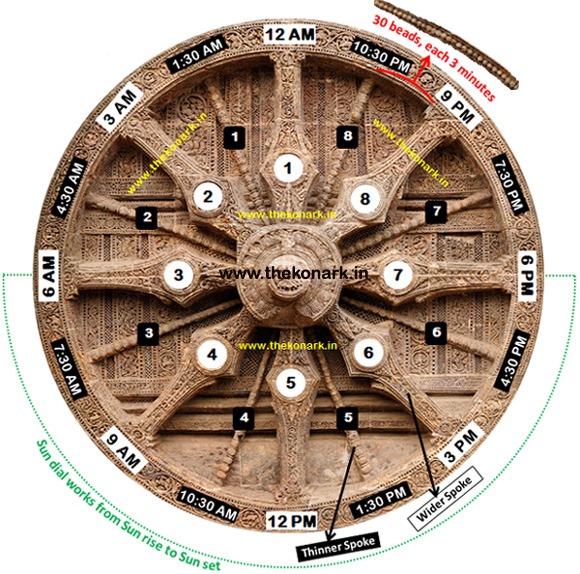
The Wheels
  • There are 24 Wheels in all [12 pairs].. 
  • Each wheel has 8 spokes [which denotes 24hours divided into eight sections of three hours each]
  • Within the wheel, at the bottom are round beads which denote 3 minutes for each. 
  • The art work on each of the wheel is different.. Some have life cycle of a woman through the day, some just have interesting sculptures..
  • You can tell the exact time by watching where the sun rays fall on the wheel.. down to the very minute!
  • There is one theory that these 12 pairs of wheels could be to represent the 12 zodiac signs. 


    [Image Source: http://www.thekonark.in/konarkwheel.html]

    The Horses
    • There are seven horses around the temple, they are known to pull the temple eastwards towards the dawn.
    • Each horse represented a day of the week..
    It took a while for the entire information and beauty of it all to sink in, and then I began wandering around the temple, to explore the various other elements in the complex. There are so many stories attached to this temple, it is mind boggling. Some that I came across are, 
    • The temple was never used as a place of prayer, because the main deity was removed/stolen/taken away... 
    • The town which was once a major port lost all business and succumbed to several pirate attacks.
    • It is said that the huge ball - lodestone that was mounted right on top was used as a navigational aid by ships. But then the magnetic powers also led to shipwrecks and some of the European ships losing their way.  Therefore the British are known to have removed this stone.
    • The temple then got a name "Black Pagoda" because it looked black and was towering like a pagoda from afar.  
    • Was declared as a UNESCO world heritage site back in 1984
    • The main sanctum is empty today, it must have housed the Sun God and his consort back in the day, but nobody really knows what happened.. 
    • Some say the temple was never completed, while others beg to differ with various stories of attacks and assaults.
    Along the gardens surrounding the temple, you will see few other shrines in ruins, and sculptures that have broken off from the main temple and kept for display, like the war elephants or the horses. There was scaffolding on almost all sides of the temple, showing us how much of damage it had withstood over time...

    As the sun beat down, so did my energy levels and I knew it was time to seek shade and cool off before exploring some more... Off i went in search of water/something to cool off, while my mind continued to wander amidst the temple complex, curious about the stories and puzzles.

    Saturday, April 21, 2018

    Applique work at Pipli


    Bhubhaneshwar, my trip in a nutshell - a jist of all that I did while in Odisha


    About 30 kms from Bhubhaneshwar, I noticed the streets lined with shops on either side showing off beautiful colourful art pieces made of cloth.  I knew I had arrived in the town of Pipli. 
     Infact, this village was established by the King of Orissa/Maharaja Birakshore of Puri
     to accommodate the craftsmen who made appliqué work pieces - umbrellas and canopies for the annual Jagannath Yatra. 

    This appliqué  work dates back to the 10th century and continues to thrive in this small village. Over time, the craftsman fell into tough times because of loss of Royal patronage and since then have begun expanding their product lines. Today, these are more of show pieces and have become part of home/office/hotel decor. Mohan, one of the guys who had a shop said his wife is the one who does most pieces, men handle the cutting and sourcing of materials. He went on to share concern about how things were changing with time and was not sure if the next generation would continue this tradition. The pieces took between few hours to few days to complete, depending on the complexity of the design and the intricate details that went into it.  Some are embellished with mirror or additional thread work adding to the appeal. Most of the pieces featured animals (the elephant and peacock mainly), flowers, birds,mythical and mythological characters with some form of geometric pattern woven within them..

    Today, we find not only umbrellas, but also wall hangings, sling bags, pouches, cushion/pillow cases, and bags [across sizes] as well.  They are quite chic and smart, for regular use.

    When I dug deep about this whole process, I discovered that the word "Appliqué" was of French origin, meaning  “appliquer”[meaning-“put on”, "apply"].  In this art of appliqué work, the craftsmen use a piece of fabric as the base and then another piece on top which is sewn into place. The designs are all patches of sorts kept on top and added in. So, they basically build layers of cloth. 

    Apart from Applique work pieces, you will also find mats and other pieces made with banana & coconut fibre in the stores around the region. They make for good gifts as well.. 

    I remember watching the Rath yatra on TV and being amazed at how beautiful the cloth covering the Rath was..

    [image source: http://gaatha.com/pipli-village-applique-work/]

    The appliqué work is used exclusively on the cloth to cover the three chariots made for the presiding deities during the Ratha Yatra or Car Festival. 

    Going with the tradition, the colours are predetermined- 
    green & red for  Balabhadra, 
    black & red for Subhadra and 

    yellow & red for Lord Jagannath...


    More stories from my trip to Orissa coming up... stay tuned~!!

    Tuesday, April 17, 2018

    Ekamra haat, Bhubaneshwar


    Bhubhaneshwar, my trip in a nutshell - a jist of all that I did while in Odisha

    After plenty of walking around and visiting three temples, I decided to take a break. Wanted to explore a bit of the town and the auto guy recommended I visit "Ekamra Haat". 

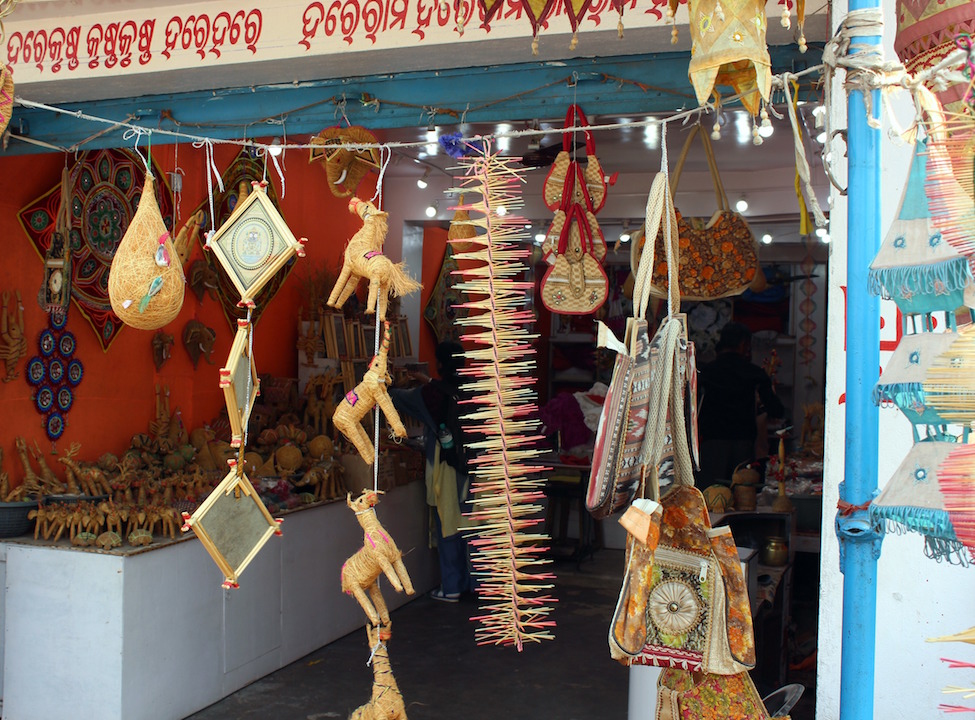
    Situated in the heart of Bhubaneshwar town, this is a huge space with shops, eateries and a space for performances as well.  Similar to Dilli Haat, but on a smaller scale was what I would describe it as. In total, it has about 40 odd shops dealing with art, craft and textile from the regions around Orissa. 

    There are spaces where you can jus sit and chill, grab a bite at one of the many outlets or do some shopping. Honestly, I wasnt very impressed with the place, it seemed quite run down and blah. Mos shops were selling the same stuff, with a bit of difference in the pricing. It was however nice to see products across ranges- stone carved pieces, wood work, applique, pattachitra, cane & bamboo work, dhokra, bell metal, terracotta, palm leaf engraving and textiles [duppattas, sarees, skirts, and so on]. 

    I did pick up a few art pieces, palm leaf bookmarks from this place. Ended up clicking a few photographs, talking to the local artisans and trying to understand the various crafts and their origins. It is a fun place if you dont have an agenda or dont mind walking around , killing time. There are eat outs strewn among the shops, so you can always grab a bottle of water/soft drink or something to eat. 


    I bought the skirt here


    Address:
    Ekamra Haat
    Madhusudam Marg, Unit 3, Ekamra Vihar, UNIT- 9, Bhubaneswar, Odisha 751001


    Friday, March 16, 2018

    Museum of Tribal Arts & Artefacts, Bhubaneshwar


    Bhubhaneshwar, my trip in a nutshell - a jist of all that I did while in Odisha

    When I planned my trip to Bhubaneshwar, I knew there were a whole bunch of places I wanted to visit. And then there was one more that caught my eye- The Museum of Tribal Arts & Artefacts [which had been established way back in 1953].  I spoke to a couple of people who have been to this town, but none knew of this nor had they been there. Anyways, the day before I left town, I had a few hours in the evening and that morning I had spent a few hours at the State Museum. The evening I decided to check this Museum of Tribal Arts & Artefacts, but then by the time I left the hotel and found an auto it was nearly 5pm, and I had read that this place shuts at 6pm. Hoping an hour was enough, I rushed into the gates, and on towards the main building. 

    There were two buildings near the gate, but they looked like they had shut for the day. I later came to know one was a shop and the other a cafe.. Oh well!! 

    The main museum was beautiful, the art and craft pieces were organised across the various rooms, and the entry/exit points was well thought of. We were not allowed to take photographs and so  I walked around, enjoying the display. Some of the words were similar to what we have in tamil, like Katri was a sharp tool here, while in tamil it means scissors.. There was also a section where a small painting session was going on. Traditional costumes such as the ringa of the Bonda tribe, phute sari of the Santhals and gatungkap of Lanjia Saora can be seen at the museum. 

    Through the museum, I came to know that there are over 60 different Tribes in Odisha, and each had distinct art, craft, clothing style, traditions and food. The museum also exhibits the huts of the Orissa tribes namely Santal, Juang, Gadaba, Saora and Kondh. Each hut is built along with their arts and artifacts, and household appliances... 

    The area leading to/around the museum and around is beautifully landscaped and the flowers were in full bloom. It was quite a sight.. Here are a few photographs from the campus.. 


    Monday, March 12, 2018

    Parashurameshwar Temple, Bhubaneshwar


    Bhubhaneshwar, my trip in a nutshell - a jist of all that I did while in Odisha


    It was one of those trips that did not involve too much planning or thinking. There was a weekend, and I knew I had a few days where work was easy.. Checked ticket rates, room availability, made sure there were no festivals around and voila, I was on a plane to Bhubaneswar..

    On my 1st afternoon in Bhubaneswar, I decided to do some exploring. I had read about the numerous temples around here, some of which were known to get real crowded and others much smaller in comparison. Even though I am not into temples, I love them for the history and stories they hide within the walls. I decided to check out three temples, that were in the same locality, literally next to each other.

    Hailed an Ola auto [now there is an interesting story, but that shall be another post] and headed to the Parashurameshwar Temple first. It was situated near a school and so there was a crowd of parents waiting anxiously. As with many other places, here too I was subjected to stares and glares, it is almost like people in our country haven't seen a girl alone, or one wearing jeans and a shirt with a camera in hand. Don't know, don't care!


    I walked into the swirling gates, figured out where to take off footwear and made my way towards the temple. It is a fairly small one, the signboard outside says 7th Century, known to be one of the oldest temples around here! I was fascinated by the architecture, which I later found was the same across all temples here. The architecture is typical of Oriyan style, with a wide range of sculptures ranging from animals, women, couples and flowers. 

    It is the first temple to have an additional structure called vimana. Though the temple is dedicated to Shiva, it contains sculpted images of Shakta deities, which are otherwise normally part of Shakta temples.

    The Jagamohana is almost rectangular with a terraced roof, sloping in two stages.  The denotes the stage of Saiva Pasupata Sect, illustrated by the frequent representation of Lakulisa. He is sculpted in Buddha-like form, with four disciples at his feet as shown on the last side of the tower, while on the West, above the relief of Nataraja, he looks like the meditating Buddha. The varandah has projecting moulding topped by a recessed frieze, demarcating bada from the gandi, a feature not found in later temples. The frieze has mostly amorous couples, separated by paneled jalis vidalas (a rampant lion, with head swung backwards, springing over a crouching elephant) at corners, a very typical symbol the beleaguered Buddhist faith.

    The inner sanctum is fairly dark and houses Lord Shiva. Apparently only two of the three original deities have survived the test of time. When you come around the temple, there is a Sahasralingam [one large Linga with 1 thousand miniature versions of itself surrounding it]

    I spent a few minutes wandering about the place, and tried to learn some of the history from the priest there. He was patient and took me around.. I noticed another temple on the other side, with just a park in the middle that seemed to be filled with people walking/lazing. As I made my way out of the temple, I could see the school crowd had vanished and all that was left was a bunch of guys on bike chewing paan and lounging under the tree.

    Stay tuned for more from Orissa or Odisha as it is called now..