Explore

About me

Am a contradiction of sorts. i love going out and having a good time with friends, and i can also stay home chill out over a book or a movie..

Am very passionate about writing, so give me a topic and watch me float away into wonderland... Love reading books- sometimes i read 3books simultaneously, crazy about music- need it all around me, all the time and ofcourse, i totally am ga ga goo goo over my 7yr old naughty brat- Floppy!! errr, Prince Floppy!! :)
Showing posts with label history. Show all posts

Friday, December 28, 2018

Lost amidst Gods in Khajuraho... Chhatarpur, Madhya Pradesh


From Corbett, we headed back to Delhi as the next leg of our journey was in the other direction. We took the night train from Delhi to Khajuraho, went to a property near the station - Pace Resorts to freshen up before heading out to explore the town... 

We decided to spend some time soaking in the temples in the western side, there are about 11 temples within one campus here.. Bought the entrance ticket and then came the ordeal of dealing with a guy who badgered us about hiring him as a guide. He would not let go, so much so that after about 20mins, one of the girls said "chalo, lets ask him to take us around and then pay him what we think is fair"... The architecture, the intricate carvings and of course the grandeur of the place is what catches your eye as you step into the gates... 

Even though Khajuraho is known for the erotic sculptures, there is more to the place and even the erotic pieces tell quite a few stories... Since it is an ASI property, it is well maintained, with manicured gardens and plenty of benches to rest on, along with a small tea shop to refresh yourself. 

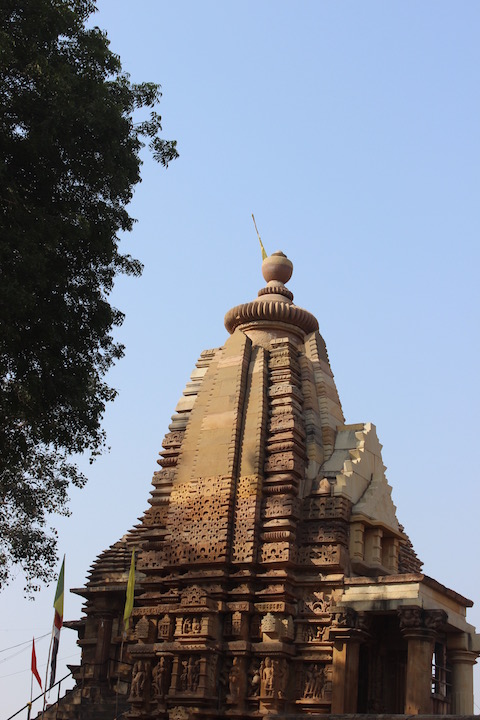
LAKSHMAN TEMPLE : This striking temple stands facing the giant Varaha Mandap. It is one of the three largest temples of Khajuraho and the western group of temples and is considered to be the earliest ( c.AD 954 ) built by the Chandella rulers. The temples faces the east and is dedeicated to vishnu, though it goes by a rather inappropriate name of Lakshman, the brother of Ram, the hero.. The temple faces the east and is dedicated to Vishnu, by a rather inappropriate name of Lakshman, the brother of Ram, the hero king of Ramayana. The temple is as tall as it is long, measuring approximately 25.9 metres in length. lt sits on a high platform which also has some interesting sculptures (royal processions, Court scenes) that you can see before ascending the temple stairs. 

KANDARIYA MAHADEV TEMPLE : While you may think all temples look the same, they store something that surprises you... This Temple is quite large and I would say magnificent, when looking at the details.. There is a small Mahadev shrine and the medium - sized Devi Jagdambi Temple, thereby accentuating its height and grandeur. 

DEVI MANDAP : Opposite the large Lakshman Temple are two small shrines. The one directly opposite is called Devi Mandap... The structure and cemented roof tells us it might be one of the newer ones.. 

VARAHA MANDAP : This Mandap stands on a tall platform, with a roof that is pyramid in shape capped with an amalaka and kalasha 

DEVI JAGADAMBI TEMPLE : One of the smaller temples in the campus, this one has a set of balconies, but only one mandap and no inner pradakshina path. Shorter in height, this and the Chitragupta Temples are quite obviously all about honouring love and conjugal harmony, with erotic sculptures of the divine couples and others depicting every mood of love. 

MAHADEV SHRINE : Between the Kandariya and the Devi jagdambi Temples is a small shrine called the Mahadev Shrine and consists of a small open - pillared porch and sanctum. A figure of the rampant lion fighting with a kneeling figure [the lion looks very different], presumed to be the emblem of the Chandellas, has some reason been installed in the porch. there are two similar rampant lion figures on the platform of the Kandariya Madadev and Devi temples.




Friday, March 9, 2018

Land's end, Bandra...


During my last visit to Mumbai, friend took it upon herself to show me around certain parts of the city I haven't been to and certain pockets that she had covered during her heritage walk escapades... The destination for today was Land's end.. I only knew of Taj Land's end hotel, and the worli sea link around Bandra, did not know the story or about the fort there. Enroute she and P [her 9yr old] told me the story about the place and I was WOWed by how much the little one knew!! :) 


For me history was a subject I dreaded all through school, just about scraping by. But then as I began travelling, I realised it was more than dates, years, and names, and thus began my love for the subject. I got curious and wanted to know more about everything I saw, heard and ate [yes even food wasnt spared]. The richness of culture, location, region, religion, people comes through the history and what we see today! Hence, the fascination....  


Anyways, there we were at Land's end. Parked the car near Taj and began walking down the road. Dont remember what day of the week it was, but it was damn crowded. We walked past a gate and a garden of sorts on our left. Did not venture into it as it was packed with couples busy lost in each others' eyes/arms and everything else.. Sigh! Looks like all parks provide the right kind of atmosphere for romance to blossom.. Who knows!! We walked past towards what looked like the Fort walls. There was a flight of steps leading up to the fort wall, again packed with kids and couples strewn all over. We spent some time soaking in the ocean, while friend continued giving me insights into the place.

 The story goes that back in 1640, the Portuguese built a fort known as Castella de Aguada (which literally translated to Fort of the Waterpoint, today also known as the Bandra Fort. It was basically built to serve as a watchtower overlooking the Mahim Bay, the Arabian Sea and the entire southern island of Mahim. 

After a few decades, around the 1850, a Parsi businessman/philanthropist [yes Bombay still has quite a Parsi population even today], Sir Byramjee Jeejeebhoy bought the entire Land's End area and decided to develop it. He built a road connecting Lands End with the rest of Bandra [Byramjee Jeejeebhoy Road], a promenade and sea-facing wall on the western side of Lands End. Little after that, in 1865 Byramjee built his own residence on top of the hill right there at Land's end.   


Today the most famous landmark out here is the Taj property. I noticed they had bought the space across from the hotel, and as we walked back to the car, I wondered if access to the fort would be restricted if they take over the entire area.. 


Anybody add to this [there isn't much online about this place]? Shall update with credits...  

Sunday, July 3, 2016

A walk through history at the Dr Bhau Daji Lad Museum, Bombay

I was heading back to Bombay after a gap of about 5years and this time I had no agenda at all. I had informed about 4-5 folks that I am coming there, and hoped to meet them if possible. I knew I wanted to spend time and catch up with a friend who had moved there 3years ago and of course explore some parts that I had not explored earlier. 

We spent the weekend generally hanging out, visiting a mall, doing some shopping [ she convinced a non shopper such as moi to also shop] and playing with their 7yr old bunny boy.. I had also made plans to catch up with a few [among the 4-5] for lunch or coffee. I knew I had a few hours and my friend mentioned the Dr Bhau Daji Lad Museum. I had been to the Prince Wales museum [Chhatrapati Shivaji Maharaj Vastu Sangrahalaya,] few years back, but this one I hadn't heard of. Did some research on the net and discovered it was in Byculla East. If the pictures and blogs I read were anything to go by, the museum promised to be magnificent visit and I headed out towards the place. 

The museum name board..

The elephant from the Elephant Islands 

The Museum in all its glory.

 Artists at work, semi precious stones, silver jug, Ganjifa is an ancient Indian card game, originally played with a set of 120 cards and asnake etched out of soap stone


 Men from Different communities on display

 Coppersmith at work

 Shell Carving 

 Beautiful peacocks at the bottom of a heavy ceramic vase.

 
The grand place that greets you as you walk into the museum..

The majestic statues and bust that sit in the museum centre.

One of the beautiful sculptures..

 And he stands tall...

 Ornate staircase leading to the top floor


 The entire upstairs.. was completely empty when i went.. was such a silent space..


The Tower of Silence

The structure standing outside, on the side

Took me a good hour to reach the museum, the journey was quite a revelation. I realised Bombay folks had taken to radio cabs like fish to water and many had stopped commuting by train. Traffic was bad, and not to mention increase in number of vehicles. The cabbie took me via the Bandra Sea link which was beautiful, quite a sight. 

Anyways, as I walked into the museum campus, I noticed there was a ticket counter with a board saying "zoo". I was surprised to see that, and anyways made my way towards the museum. On the side sat the majestic elephant [it is a Basalt elephant sculpture from Elephanta Island] with a canon of sorts guarding it. There was a guy sitting next to it, but he very sweetly got up and walked aside when he saw me position my camera for a capture. After buying an entry ticket for Rs10 [reminded me of the ticket at Albert Museum in Jaipur, same price], I made my way inside. There was no major security checks, only thing the staff inside told me was to not speak on the phone while inside. 

Also known as the Victoria and Albert Museum, this museum was built back in 1872 and is a treasure house of anything related to history- Historical artefacts  paintings, pots, pans, photographs, and so much more from across the country. What made the visit interesting were the information cards near the exhibits. They were in both Hindi & English and quite detailed. The displays themselves had boards in both languages and they were all neat and organised.  The instant you step inside, you are in awe of the architecture of the place. It was like a palace, simply wow.I must have spent close to two hours here, walking the length of the museum, exploring the two floors. 

As you head towards the staircase you can't help but notice the cluster of sculptures that stand tall. The man standing tall is David Sassoon – opium baron, trader and architect of Colonial Bombay. There are quite a few buildings around the city named after him- David Sassoon Library & Reading Room at Kalaghoda. Apart from Sasoon the other statues belong to Prince Albert who stands just behind him. There are two women who are on either side of the Prince, did not notice their names though.  

While the ground floor was filled with artefacts and pieces from across the country, the top floor showcased historic maps, model ships, models of Bombay life in the 19th and 20th centuries. the one fascinating exhibit was the Towers of Silence.. I have not heard of it and so it had me enthralled. I learnt that it  is where the bodies of Parsis or Zorashtrians are laid after they die. It’s an open well of sorts, and vultures eat the remains of the departed.

As I walked out towards the Museum Shop, I spotted the tall tower on the side of the museum. The museum shop has a small but cool collection of items that you could purchase, from bookmarks to t-shirts, mugs, posters, games, coasters and so on. 

Interesting insights.. [source http://www.mumbai.org.uk/museums/victoria-albert-museum.html]

History

The Victoria and Albert Museum was originally established in 1855 in Mumbai. During this time, the museum was used as a treasure house of the decorative and industrial arts. The thought of establishing a museum was suggested by a collector known as Dr. Buist, when the India was under the control of British East India Company. Dr. Ramkrishna Vitthal Lad, also known as Dr. Bhau planned the construction of the museum with an amount of Rs. 6000. After a committee was formed, the foundation for building the museum was laid down in 1862. The construction was complete only in 1871 and the museum was opened in 1872. The museum is presently known as 'Dr. Bhau Daji Lad Museum'. It was renamed after Dr Bhau Daji Lad because of his dedication to the museum.

Architecture
The initial appearance of the Victoria and Albert Museum had a gloomy look but now, after the various contributions put forth by the 'Indian National Trust for Art and Cultural Heritage (INTACH), the museum has improved in its appearance. The museum is adorned with gold ornamentations on the corners of the walls, railings and ceilings. The blue-painted pillars add magnificence to the museum's look. The entire construction of the museum is inspired by the Greco-Roman style of architecture. Apart from the arches that are elegantly designed and the heavy glass cases, the high painted ceilings of the museum is also a work of expertise. The 'Victoria Gardens' or 'Rani Jijamata Udyan', serves as a backdrop for this ancient museum.


DR. BHAU DAJI LAD MUSEUM
91 A, Rani Baug, 
Veer Mata Jijbai Bhonsle Udyan,
Dr Baba Saheb Ambedkar Marg, 
Byculla East, 
Mumbai, Maharashtra 400027.
India.

Phone:
+91-22-23731234
+91-22-65560394

Sunday, February 15, 2015

Jim Thompson's house, Bangkok

When I was planning my Bangkok trip, as always I did do a bit of research and one of the places that cropped up in almost all the sites was a visit to Jim Thompson's house. A friend of mine who had been to Bangkok earlier also recommended the place. 

So one afternoon, we hopped on the BTS, and headed towards the House. [We are staying at Sukumwit 11, and so from there we had to take the sky train to Siam BTS, get off from the Sukhumvit Line train, search for National Stadium sign and get into the Silom Line Train the platform. In National Stadium (W1), take the exit 1, walk on, then you'll see the house at about 200 meters from the main road.] 

It is located down a narrow lane that ends with a view of the canal. We saw quite a few boats speed by while we had lunch at the restaurant inside the Jim Thompson house, which is more of a museum of his works and life. 


I bought a ticket for 100Baht [friend decided to sit this out] and signed up for the next available tour [ 40mins is the duration of the tour]. The place is filled with Thai structures that Jim Thompson, an American businessman collected from all parts of Thailand during the 1950s and 1960s. While he was building his silk company, he also became a major collector of Southeast Asian art, which at the time was not well-known internationally. He built a large collection of Buddhist and secular art not only from Thailand but from Burma, Cambodia, and Laos, frequently travelling to those countries on buying trips. It was in 1958 that he began to put together a home to showcase his art collection. Formed from parts of six antique Thai houses, his home (completed in 1959) sits on a klong (canal) across from Bangkrua, where his weavers were then located. Most of the 19th-century houses were dismantled and moved from Ayutthaya, but the largest, a weaver's house (now the living room), came from Bangkrua. 

You walk along a beautifully done up garden to explore the various buildings, see the fine art pieces and to get a glimpse of what his life was like. And when you are done, you can also check out the store near the restaurant where a few products are available for sale [ beautiful but pricey]. And then there is the small art performance done by two women just outside the store. They are so elegant and graceful, was quite a sight to watch. 

And when you are done, there is a small shuttle of sorts that will drop you off at the main road which is within walking distance from the station. 

Update: Read this article and thought I should share it here- Read this next The Case of the Missing Thai Silk King Flashback The Case of the Missing Thai Silk King Much more
 

Saturday, November 22, 2014

Exploring Galle, Sri Lanka

There we were in our last leg of the trip, heading towards Galle before driving back down to Colombo for a day's rest before catching our flight back home. While down from Unawatuna, our cab driver told us the Galle fort area is a must see. We trusted his judgement and allowed him to show us around. 


We drove through an archway, the walls resembling that of an old fort. It was indeed a Fort, the Galle Fort. There was a mini city of sorts within these walls, there were buildings, there were court houses, stores [including a Gems& jewellery store- our cabbie told us the prices here will be crazy as they target international tourists], narrow lanes with cute looking houses lined up on either sides and then of course on the other side was the long running Fort wall beyond which lay the beautiful blue ocean. We got off near a staircase, walking up the fort wall and along it taking it all in. From the height, we spotted a temple, a church and a few tall buildings as well.

Suddenly, we noticed a small cafe near one of the pretty lanes. We went over to explore the place, discovered it was a quaint bed & breakfast places besides which was a cart selling stuffed paratha of sorts. Decided to indulge and bought one stuffed paratha and it was divine.. Wish we had known about this homestead, we would have planned better and maybe stayed in Galle one night. 

We hopped into the cab and drove around till we came to a Court house where we spotted a newly married couple walking down in all their wedding finery. The groom was decked up in a gold suit with a maroon velvet vest and a beautiful headgear, the bride was in a saree and wore so much jewellery I was amazed she dint need help standing upright. There was an entourage following them, all dressed in identical outfits, and a photographer with his gear as well. As we drove along, we spotted quit a few similar groups around. My friend in fact took a picture with one of the married couples who happily posed :) 

On our way towards Colombo, I decided to read up on Galle from the pamphlet I had picked up. I came to know,

The fort was built first in 1588 by Portuguese, subsequently fortified by the Dutch sometime in the 17th Century. What is amazing is that the place which is nearly 423years old stands tall and majestic even today, courtesy the Archaeological Department of Sri Lanka. It is also referred to as the Dutch Fort or the "Ramparts of Galle".

To know more, click here